
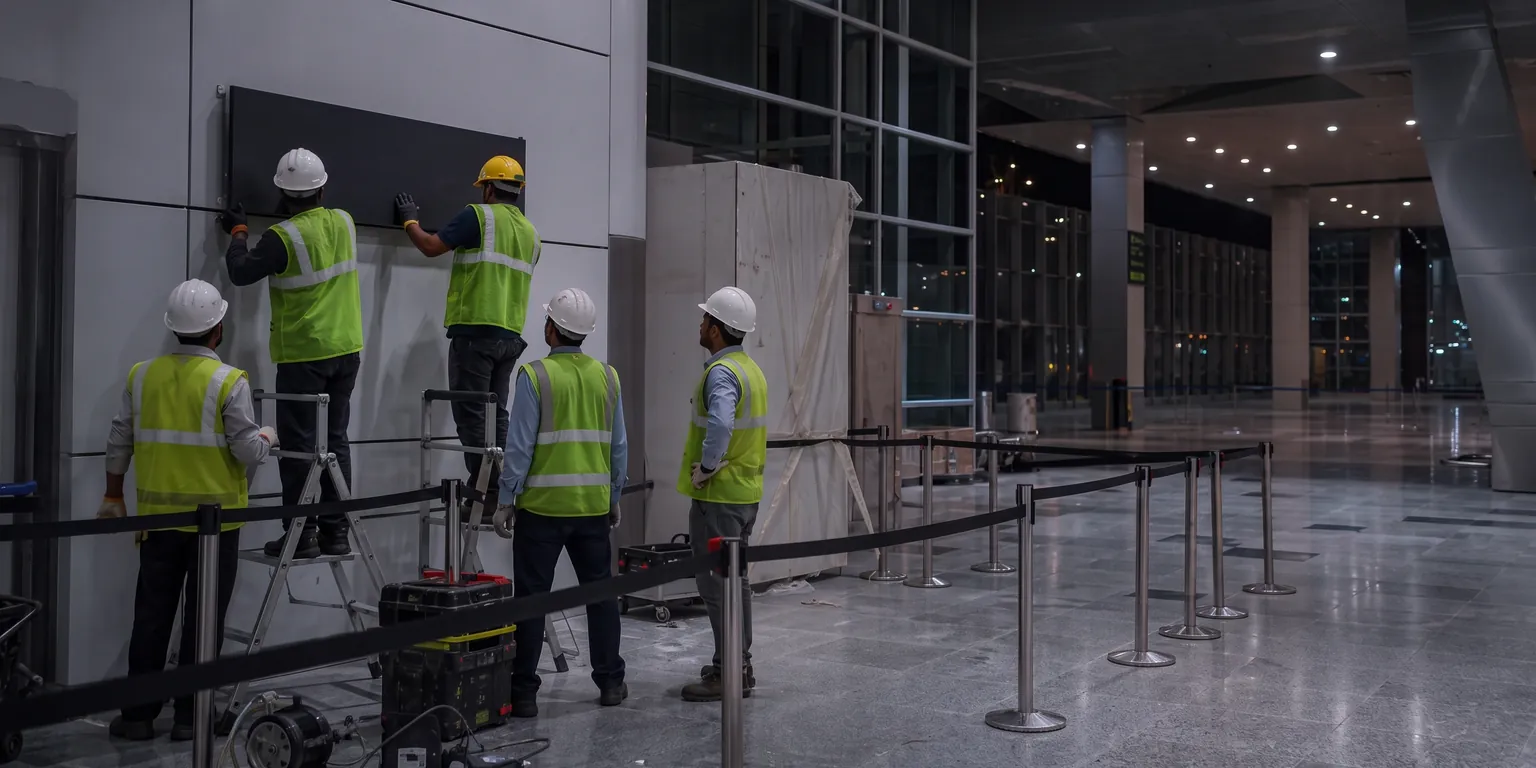
IBS Achieves BCAS Clearance for Airport Fit-Out Work: What It Means for Aviation Clients
Impulse Branding Solutions holds company-level BCAS (Bureau of Civil Aviation Security) security clearance and has delivered airport interior work. Personnel access is arranged for each project.
What BCAS clearance means in practice
BCAS is the Bureau of Civil Aviation Security under the Ministry of Civil Aviation. IBS holds a company-level security clearance document. Individual personnel still require the access permissions applicable to each assignment.
For airport retail tenants and operators, company-level clearance is one part of mobilisation. IBS coordinates site-specific personnel access and security requirements with the airport operator and client.
What IBS can now execute inside airport terminals
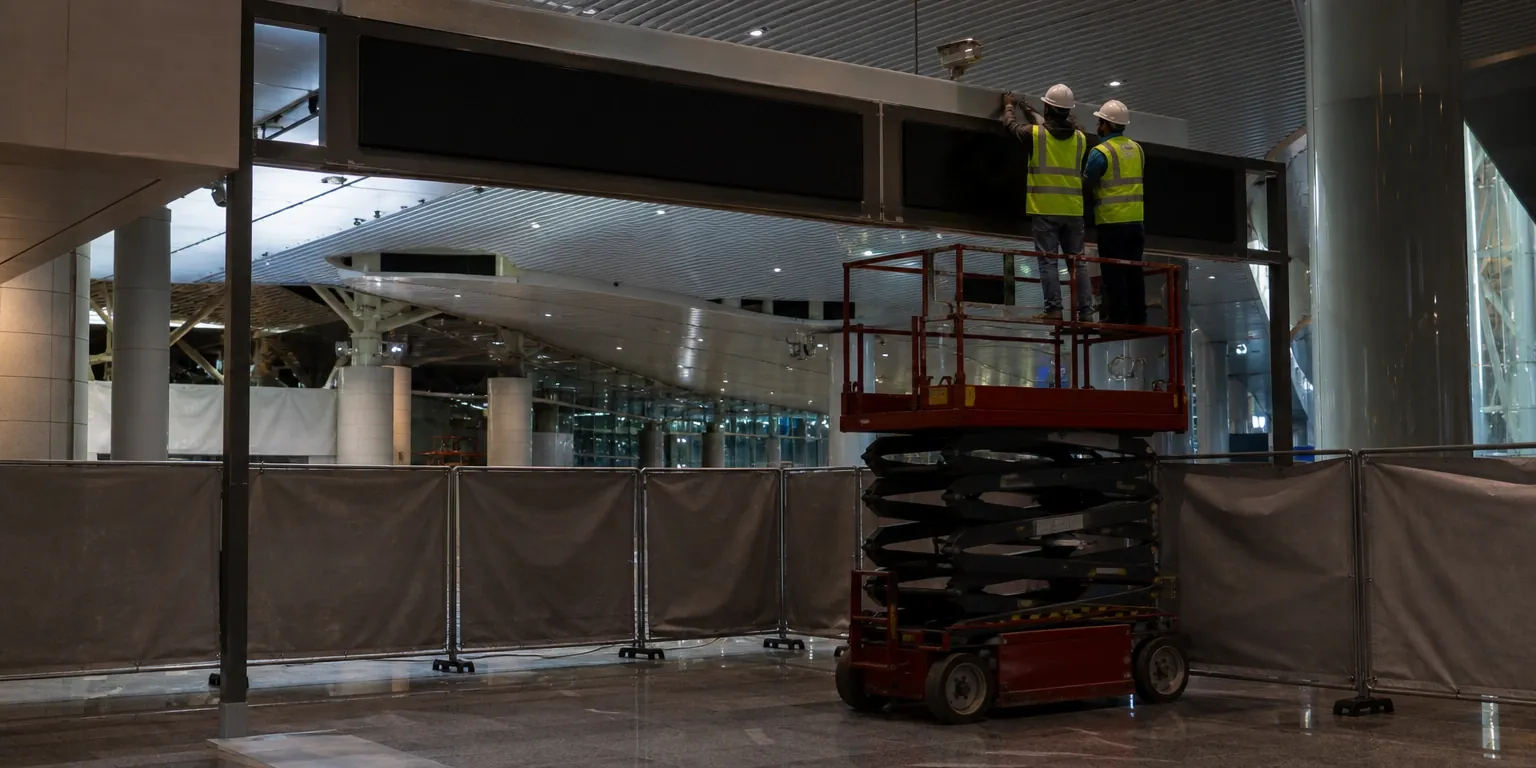
With BCAS clearance and our existing SITC capability, IBS can execute: wayfinding and directional signage programmes for airport operators; retail fit-out for tenants in both landside and airside commercial zones; F&B and lounge interiors; fascia, pylon, and departure hall branding; and in-terminal advertising and display installations.
We are already engaged with Adani Airports on wayfinding signage at multiple airports in the Adani network. Our BCAS clearance was a pre-condition of that engagement and remains a standing qualification for all airport work.
Why clearance is a genuine barrier, not a formality
It is also one of the few claims in this industry that cannot be softened. A contractor either holds it or does not, and the airport operator can confirm which. That makes it unusually useful to a procurement team, because most vendor differentiation in fit-out and signage rests on assertions that are difficult to test before award.
Most credentials a contractor advertises are quality claims. BCAS clearance is different: without it, a vendor physically cannot reach the work, regardless of how capable they are.
That makes it one of the few claims in this industry that is binary and externally verifiable, which is also why it is worth asking any aviation contractor to evidence rather than assert.
- Vetting applies to the company and to each individual who will work airside
- Passes are issued per person per project, with lead time before mobilisation
- Movement airside is escorted, including for material and tool movement
- Tools and materials taken airside are counted in and counted out
- An uncleared vendor must subcontract to a cleared one, at their price and pace
What changes on an airport site
Clearance gets a contractor to the work. The programme is then shaped by constraints that do not exist on a commercial site, and pricing an airport job on commercial assumptions is the usual reason a bid fails to hold.
- Night-only working windows around terminal operating hours
- Fire-retardant material grades on anything inside the terminal envelope
- Wayfinding to the airport operator's own signage manual, which overrides tenant brand guidelines
- Mounting details engineered for public-area loading and vandal resistance
- Deliveries scheduled through controlled access rather than to a site gate
- Work zones handed back clean and safe at the end of every shift
What to ask an aviation contractor
These questions separate a contractor who has genuinely worked airside from one who has quoted for it. Worth asking IBS the same way.
- Do you hold BCAS clearance, and at which airports have you used it?
- How many of your personnel are currently cleared, and what is the lead time to clear more?
- Name an airside project, the operator and the scope delivered
- Which parts of the scope do you subcontract, and are those parties cleared?
- How is your price affected if the access window changes after award?
- How do you handle material control airside, in practice?
Planning an airside programme realistically
A useful sanity check is to convert the programme into productive hours rather than calendar days. A four-week airside window with six-hour night shifts, of which roughly an hour goes to escort, screening and material movement, is not four weeks of work. Contractors who have done this before price it that way, and their number looks high against a bid that has quietly assumed a normal working day.
The commonest failure on an airport project is a programme written as though it were a commercial site with a night shift. Access, not construction, sets the pace.
- Pass lead time for every individual, built in before mobilisation rather than after award
- Productive hours per shift, which are shorter than shift length once escort and screening are counted
- Material staging, since airside storage is usually restricted or unavailable
- Contingency for shifts lost to operational disruption, which is normal rather than exceptional
- Approval time for the operator to review signage against its own manual
- A stated position on what happens to price and programme if the access window changes
What clearance does not cover
The practical consequence for a procurement team is that BCAS clearance belongs in the qualification stage, not the evaluation stage. It determines who is allowed to bid at all. Once past it, the criteria that separate bidders are the ordinary ones: production capacity, named airside references, how the access constraints have been priced, and whether the operator's signage manual has been read rather than acknowledged. A shortlist built on the credential alone will contain contractors whose only aviation experience is holding the credential.
Clearance is necessary and not sufficient. It gets vetted people to the work; it says nothing about whether the contractor can build to the operator's standard once they are there.
Treating the credential as the whole qualification is a common procurement error on aviation projects, because it is the one criterion that is easy to check.
- It says nothing about fabrication quality or the contractor's own production capacity
- It does not grant site access: passes are still issued per airport and per project by the operator
- It does not cover subcontractors, who need their own clearance
- It does not imply familiarity with the operator's signage manual
- It does not price the access constraints, which is where airport bids usually fail
- It carries no warranty implication: defect liability is still a contract term to negotiate
How an aviation tender should be structured
An airport tender priced like a commercial one will either be withdrawn or become a variation argument. Structuring it around access rather than around area is what makes the bids comparable.
The clauses below are what separate a bid that holds from one that is simply the lowest number on the day of award.
- State the access window in the tender, and require pricing against it explicitly
- Require bidders to state how many cleared personnel they hold today
- Require the operator's signage manual to be acknowledged in the bid
- Separate preliminaries for escort, screening and material control as named lines
- State what happens to price and programme if the access window changes after award
- Require a named airside project reference with the operator and scope
- Require subcontractor clearance status to be declared at bid stage
Sources
- Airside work inside an active Indian airport terminal requires clearance from the Bureau of Civil Aviation Security. The credential is verifiable through BCAS and through the airport operator. Bureau of Civil Aviation Security, the issuing authority
- Public capital expenditure in the Union Budget 2026-27 rose to Rs. 12.22 lakh crore (US$ 135.8 billion), from Rs. 10.96 lakh crore in FY25-26, with roughly Rs. 143 lakh crore of infrastructure spending planned across FY24 to FY30. IBEF, Infrastructure Sector in India, updated February 2026
Frequently asked questions
What is BCAS clearance?
What is the difference between airside and landside?
Can an uncleared contractor work at an airport?
How can a client verify a contractor holds clearance?
Does clearance cover every airport?
Why is airport work more expensive?
What signage standard applies inside a terminal?
What has IBS delivered under its clearance?



In-house execution.
Single-point accountability.
From signage and in-branch graphics to full interior fit-outs. IBS manufactures and executes in-house, pan-India.