Multi-City Retail Rollouts: The Signage Consistency Problem Nobody Talks About
When a QSR brand or bank opened 12 new locations a year, city-level signage vendors worked adequately. When the same brand moves to 50 openings annually across Tier-1, Tier-2, and Tier-3 cities, the local-vendor model breaks. Colour shifts, material substitutions, and fabrication quality variance become visible, and they are visible exactly where your brand is trying to make its first impression.
Why local vendor networks fail at scale
Local signage vendors serve their market adequately when the order volume is low and the client is on-site to supervise. At scale, 50+ simultaneous or sequential openings, the local-vendor model produces consistent failure modes: Pantone drift (the orange on your fascia sign in Nagpur does not match the orange in Gurgaon), material substitution (flex replacing acrylic because local procurement is tight), and fabrication tolerance variation (letter heights off by 5–10% because templating is done by eye rather than to GFC drawings).
The brand cost of this is difficult to measure but real. A survey of BFSI branch managers conducted by IBS across 40 locations in 2024 found that 34% of branch managers reported noticing material or colour differences between their branch signage and the brand standard, differences the marketing team was not aware of.
How in-house manufacturing solves the consistency problem
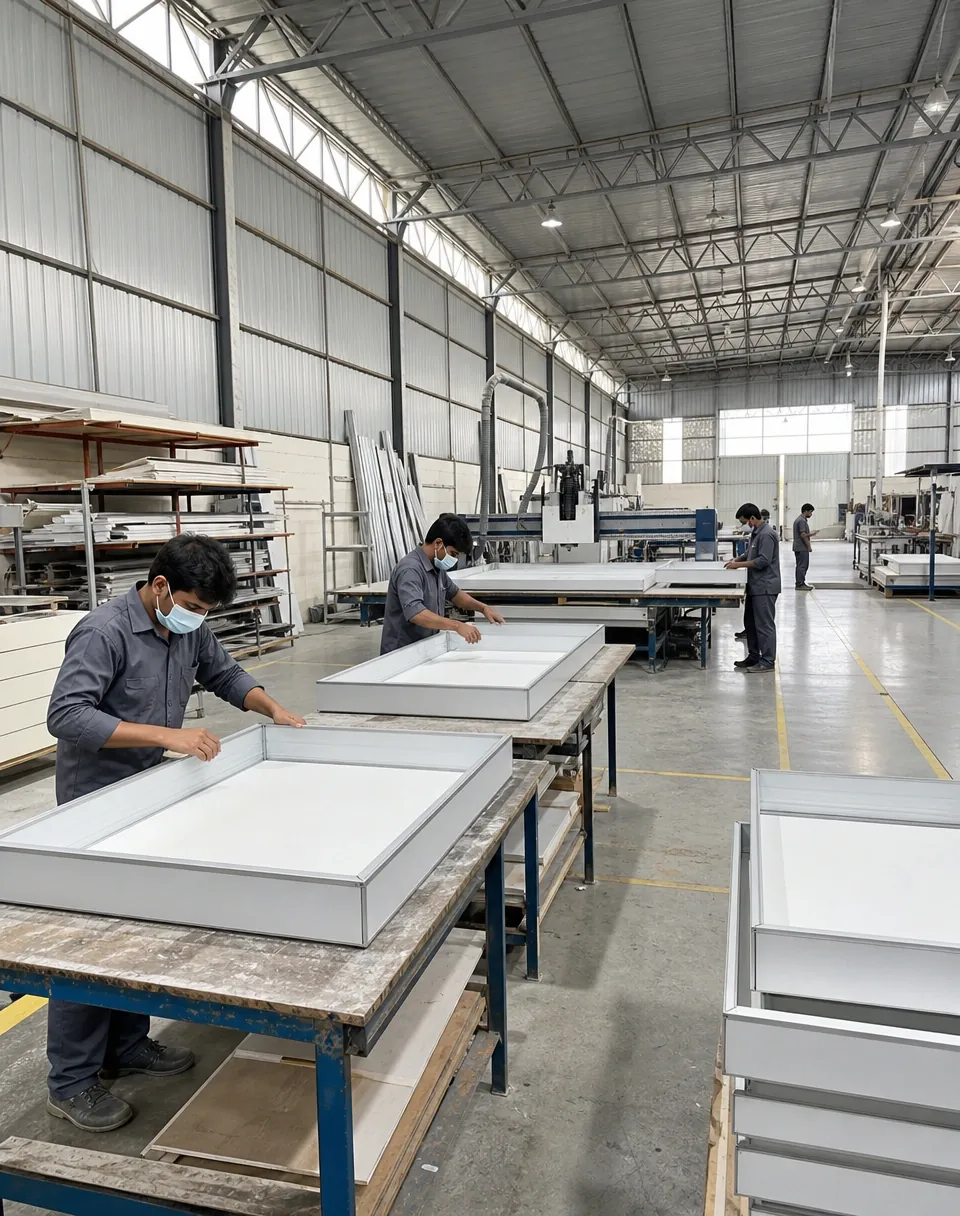
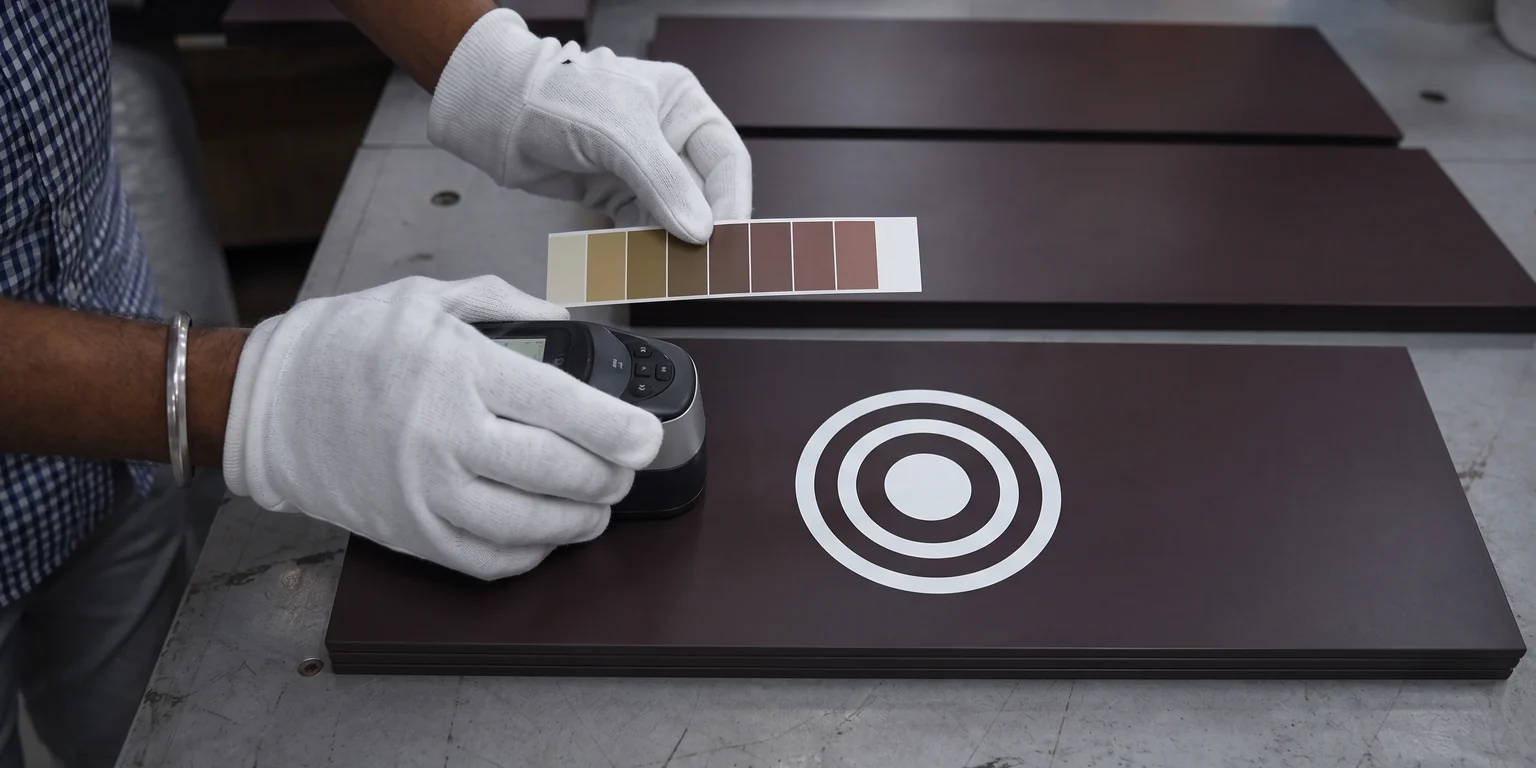
When signage is manufactured in a single controlled facility, same raw material stocks, same CNC routing, same colour-calibrated printing, Pantone consistency is structural, not dependent on individual vendor quality control. The manufactured panels ship to the installation city; only the installation crew is local.
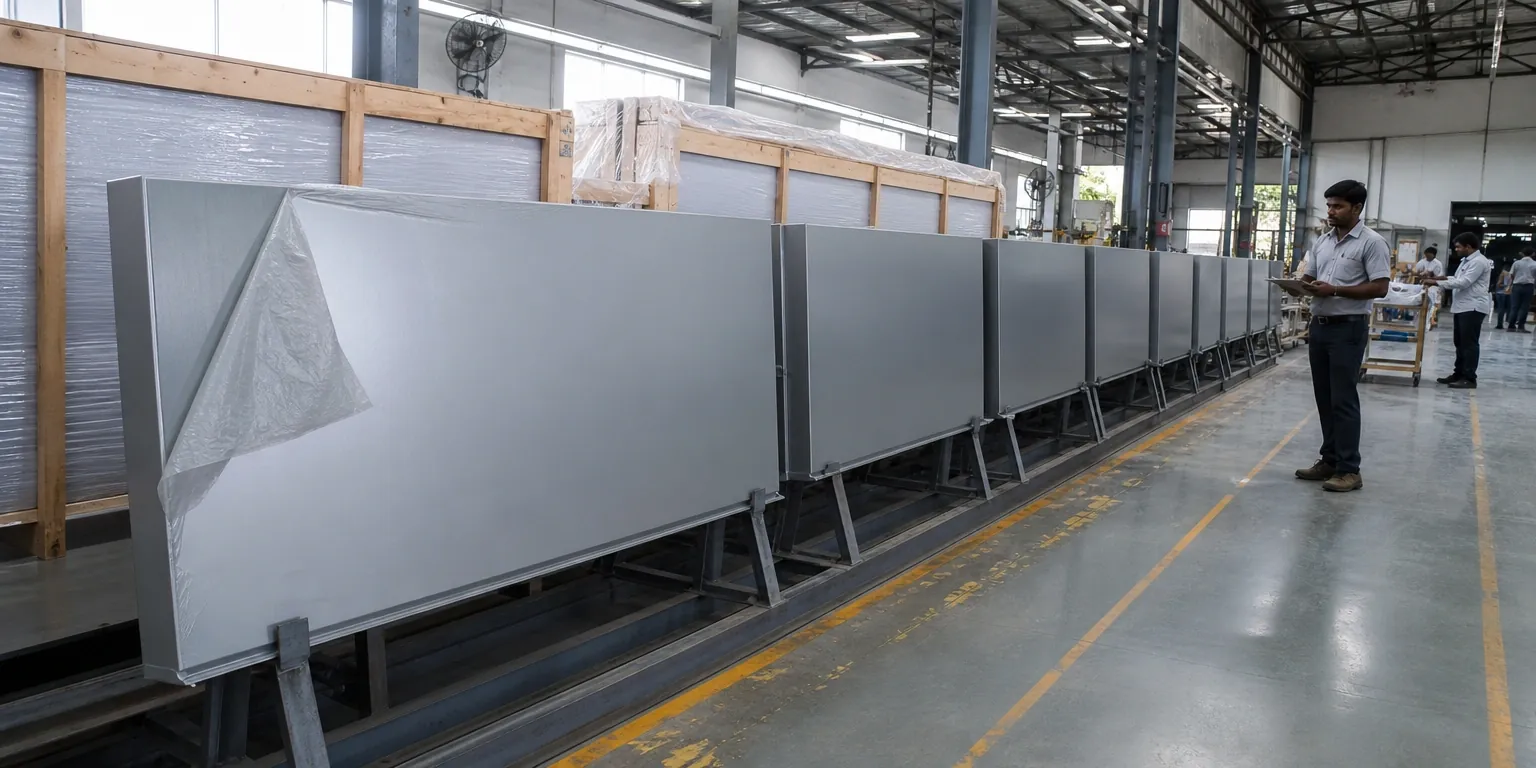
IBS's in-house manufacturing facility in Mumbai produces all signage, LED channel letters, ACP panels, pylon signs, fascia elements, from a single production line calibrated to client brand standards. IBS has delivered branch branding work for IDFC Bank across India.
How specification drift actually happens
Nobody decides to make store 140 different from store 1. Drift is the accumulated result of small, individually reasonable local decisions, none of which is visible from head office.
- A local vendor substitutes an available material for the specified one to hold a date
- Each vendor proofs colour on its own equipment, against its own reference
- A brand manual is interpreted rather than measured, because no physical swatch was issued
- A fascia is resized to fit a shopfront nobody surveyed before fabrication
- A driver is substituted downward on a competitive re-quote in month four
- Nobody photographs the finished installation, so the variance is never seen
The controls that actually hold a rollout together
Consistency across a network is a production and quality-control problem, not a design problem. These are the mechanisms that hold it.
- One production batch for the whole programme wherever lead time allows
- A single approved physical swatch, held centrally, that every batch is checked against
- Travelling installation crews rather than a different local vendor per city
- A kit-of-parts design, so a store can be built to the same result anywhere
- As-built photographs of every location, so the network is verifiable without visits
- A named project lead holding the whole programme rather than one per region
What to ask a rollout vendor for, before award
Most of these are cheap to provide if the vendor genuinely works this way, and impossible to provide if they do not. That is what makes them useful questions.
- A named rollout of comparable site count, with the client and the window
- Their production plan: batch sizes, sequencing and where fabrication happens
- How colour is controlled between batches, specifically
- Whether installation crews travel or are appointed locally per city
- What evidence of completion you receive per site, and in what format
- Who you call in month seven, and whether they will hold the original specification
Sequencing a rollout against trading dates
The practical consequence is that production should run ahead of the access schedule rather than in step with it, holding finished stock against sites that are not yet available. That costs working capital and buys the ability to install the moment a landlord opens a window, which on a compressed retail programme is usually the constraint that decides whether the estate opens on time.
A rollout programme is usually paced by site access rather than by production capacity, which is the opposite of what most plans assume.
- Survey every site before fabrication, because shopfronts are rarely the dimension on the drawing
- Batch production ahead of the access window rather than in step with it
- Sequence installation by geography to keep travelling crews productive
- Protect festive and peak trading weeks, when landlords restrict working entirely
- Hold a small buffer stock for damage in transit, which is inevitable at volume
- Confirm each landlord approval before the batch for that site is produced
Who owns the specification once the rollout starts
Governance sounds like overhead on a twenty-store programme and turns out to be the cheapest line on a two-hundred-store one. The reason is that a deviation approved informally at site forty is invisible until site one hundred and forty, by which point it has become the de facto standard and correcting it means revisiting a hundred locations rather than one.
Drift is a governance failure before it is a manufacturing one. Once a programme is running across cities and months, the question is who is allowed to approve a deviation, and whether that decision is recorded anywhere.
On well-run programmes the answer is one named person at the brand and one named project lead at the vendor, with everything else escalating to them. On programmes that drift, the answer is whoever is on site that day.
- One named specification owner at the brand, with authority to approve deviations
- One named project lead at the vendor, holding the whole programme rather than a region
- A written change log, so a deviation approved for one site does not silently become the standard
- A single held physical swatch, with its location and custodian recorded
- Site surveys returned to the specification owner before fabrication, not after
- A closing review comparing as-built photographs across the network, not a sample
What a rollout costs when it goes wrong
The cost of inconsistency is rarely budgeted, because it lands after the programme has closed and is absorbed by different teams than the one that ran it.
Quantifying it before award is what makes the case for centralised production, since the per-site saving from a local vendor is usually smaller than any single line below.
- Re-fabrication and reinstallation at sites that failed brand review
- Travel and management time spent auditing sites that should not need auditing
- Delay to store openings where signage is rejected on arrival
- Brand equity cost of a network that visibly does not match, which is real and hard to price
- Fragmented warranty, with each site's claim going to a different party
- Replacement parts colour-matched by eye because no original file was retained
- The eventual cost of a re-standardisation programme across the whole estate
Sources
- Retail leasing across India’s top seven cities reached a record 8.9 million sq ft in 2025, and Zudio alone moved from roughly 341 to 765 outlets across 235 cities in FY25. IBEF, Indian Retail Industry, updated February 2026
- India’s digital signage market was valued at USD 1,074.5 Million in 2025 and is forecast to reach USD 3,494.3 Million by 2034, a 14.00% CAGR. IMARC Group, India Digital Signage Market, base year 2025
Frequently asked questions
Why does signage look different across our stores?
How many sites before consistency becomes a real problem?
Is a local vendor per city cheaper?
How do I verify site 140 matches site 1 without visiting?
What is a kit-of-parts approach?
How fast can a large rollout realistically run?
Who handles local permissions across many cities?
What happens when a store needs a replacement two years later?
In-house execution.
Single-point accountability.
From signage and in-branch graphics to full interior fit-outs. IBS manufactures and executes in-house, pan-India.