LED vs. Non-Lit Signage: Which Works Harder for Your Brand?
Brand managers often frame the LED vs. non-lit signage decision as a budget question. It is not. It is a visibility question, and the answer depends entirely on where your signage is seen and by whom.
When LED signage wins on ROI
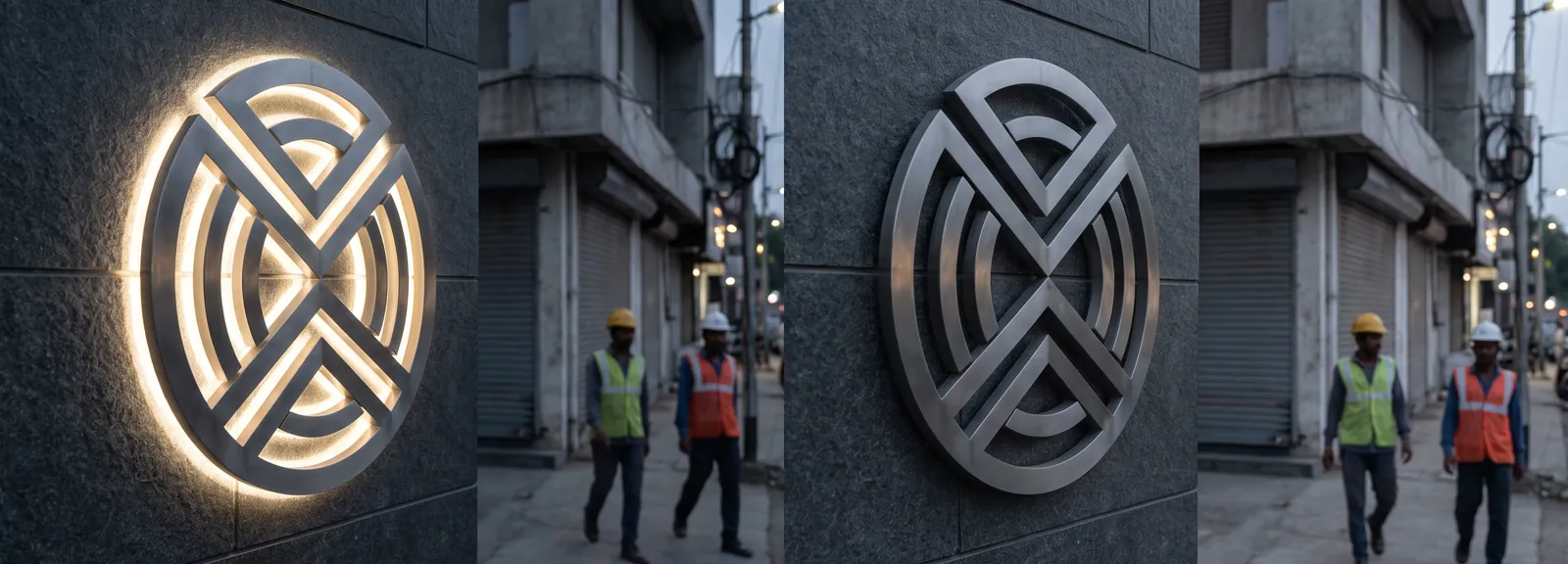
LED backlit channel letters and glow signs outperform non-lit alternatives in three specific environments: high-ambient-light retail facades where daylight competes with signage visibility; interior wayfinding in large commercial complexes where ceiling height reduces the impact of non-lit elements; and any signage that is viewed after dark, airports, highways, hospitality facades, 24-hour retail.
The operational cost of LED has dropped substantially. A well-manufactured LED module array consumes 60–70% less power than equivalent neon or fluorescent backlighting, and the rated life is 50,000+ hours at constant operation, roughly 17 years at 8 hours/day. Power cost over a 7-year life cycle is ₹40,000–₹80,000 for a standard fascia sign, depending on size and local tariff.
When non-lit signage is the right specification
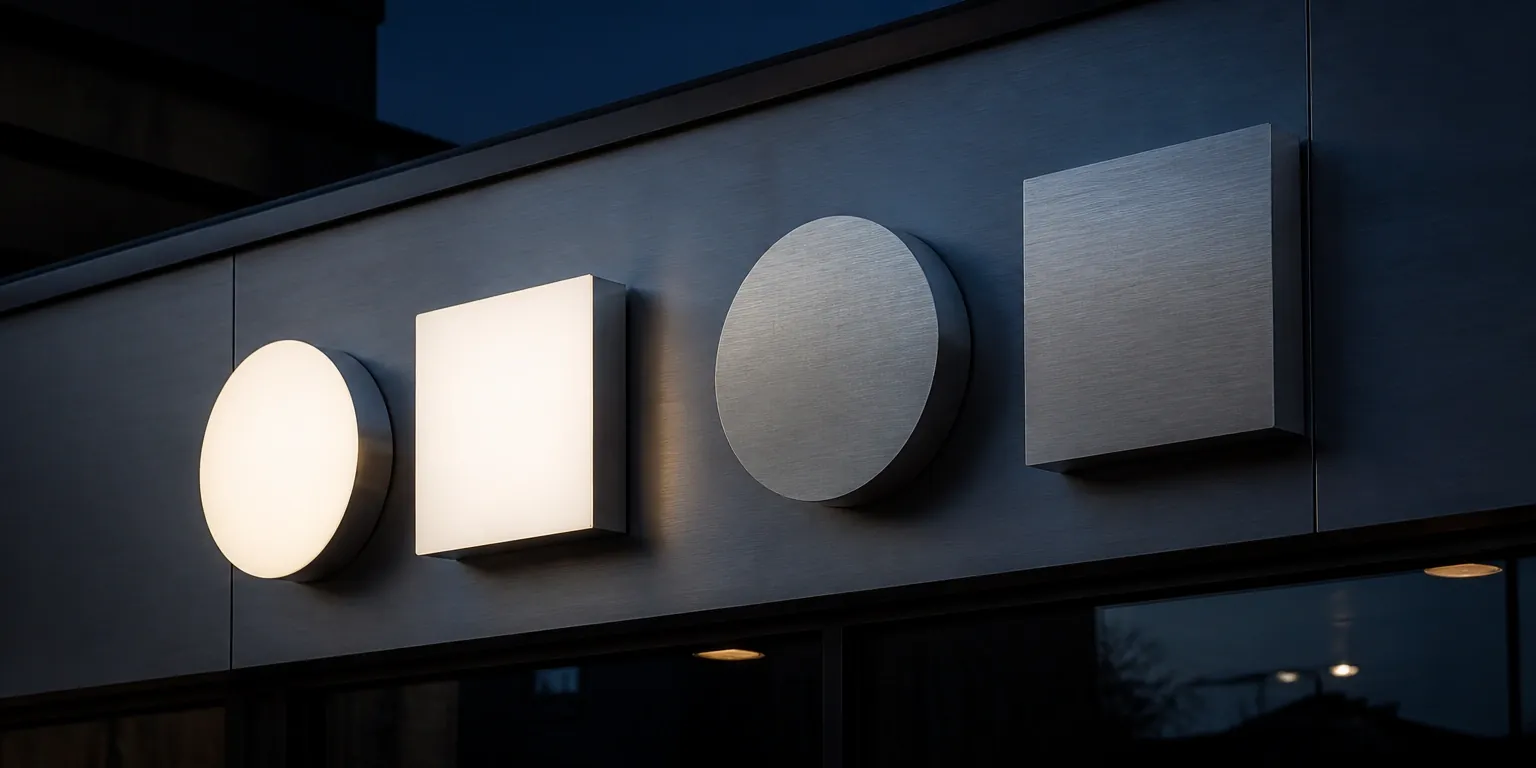
Inside a well-lit commercial office lobby, LED channel letters are often over-specified. The ambient light level is sufficient for non-lit cut-out lettering or ACP-faced dimensional letters to carry the brand clearly. Adding LED backlighting adds ₹15,000–₹40,000 to the unit cost and requires an electrical infrastructure run that may not be justified.
Non-lit signage is also significantly easier to maintain, no driver failure risk, no module replacement, no electrical inspection requirement. For a national banking chain with 400+ branches, the maintenance cost differential across a non-lit programme is material over 5 years.
Making the specification decision
Specify LED when: the sign is externally mounted and visible after dark; the retail or hospitality brand requires consistent visibility across high-ambient locations; or when the brand guidelines mandate illuminated exteriors.
Specify non-lit when: the installation is interior, in a well-lit environment; the network includes 50+ locations where maintenance cost is a real factor; or when the architectural specification calls for flush-mounted ACP panels where LED backlighting would be invisible.
The seven-year cost, not the purchase price
A lit sign and a non-lit sign of the same size are not comparable purchases. One has a running cost, a failure mode and a maintenance access requirement; the other largely does not.
Comparing them honestly means pricing the whole life, and the components that decide that life are the ones most often left generic on a quotation.
- Purchase and installation, including any structural or electrical provision
- Running cost: connected load, hours of operation, tariff
- Driver replacement, which is the component that fails first on a lit sign
- Module replacement and the colour-match risk of doing it years later
- Access cost for maintenance at height, often larger than the part itself
- Cleaning, which a lit face needs more visibly than an unlit one
The specification lines that actually decide performance
Two quotations for the same lit sign can differ by a factor of two, and the difference is almost never the fabrication. It is in these lines, which is why they should be named rather than described generically.
- Driver brand named, not written as "LED driver". Mean Well and Schneider are the common quality reference points
- LED module class and binning, which decides whether the face lights evenly
- Ingress protection to IP65 minimum for anything outdoors
- Face material: flex, acrylic or ACP, each with a different lifespan and repair path
- Diffuser specification, which is what prevents hotspots and dark banding
- Warranty split: workmanship versus manufacturer pass-through on the electrical parts
How the choice usually resolves in practice
Set aside preference and the decision is usually forced by the site rather than the brand. These are the conditions under which each option is the obvious answer.
- Lit: the sign must read after dark, or competes with high ambient daylight on a facade
- Lit: dwell time is short, such as a road frontage where the sign has one second to register
- Non-lit: the sign is inside a well-lit interior where illumination adds nothing
- Non-lit: the landlord or mall prohibits illuminated fascia, which is common
- Non-lit: maintenance access is difficult enough that a failed driver would stay failed
- Either: where a halo-lit treatment gives night presence at lower load than a full lit box
What maintenance actually looks like, three years in
The specification decisions made at purchase determine what a failure costs later. This is the part of the comparison that never appears on a quotation.
- A failed driver on an accessible fascia is a short job; the same failure at height needs access equipment
- A module replaced three years later rarely colour-matches its neighbours exactly
- A flex face can be replaced without touching the structure; an acrylic face often cannot
- Spares held against the original specification avoid a nearest-match substitution
- Warranty claims split between fabricator and installer stall; a single claim point does not
- A sign left dark because nobody owns the fix does more brand damage than no sign at all
The approvals that decide what you can actually install
A signage specification is often settled before anyone checks whether it is permitted, which is why fascia designs get redrawn after fabrication has been quoted. The approval path runs in parallel with design and should start at the same time.
There are usually two separate consents, and satisfying one says nothing about the other. Municipal permission governs the public realm; the landlord or mall governs the building.
- Municipal signage permission, with drawings and technical documentation prepared
- Landlord or mall fascia approval, governed by fit-out guidelines rather than by law
- Permitted illumination type, brightness and operating hours, often prescribed by the mall
- Projection limits over the public realm, which constrain box depth
- Structural sign-off where the sign loads the facade rather than a wall
- Heritage or precinct restrictions, which override both of the above where they apply
Specifying for the site you have, not the render
Signage decisions are usually made from an elevation drawing and a night render, neither of which shows the conditions the sign will actually live in. A site visit at the hour the sign matters most is worth more than another design revision.
The variables below change the specification more than any aesthetic preference does, and all of them are observable on site in twenty minutes.
- Ambient light at the sign's location, by day and after dark
- Viewing distance and approach angle, which set minimum letter height
- Dwell time: a road frontage has one second, a lobby has ten
- Available power and whether a new circuit is needed
- Maintenance access, and what equipment a driver replacement would require
- Substrate and structural capacity behind the mounting position
- Whether neighbouring signage will compete for attention at the same brightness
Sources
- India’s digital signage market was valued at USD 1,074.5 Million in 2025 and is forecast to reach USD 3,494.3 Million by 2034, a 14.00% CAGR. IMARC Group, India Digital Signage Market, base year 2025
- Retail leasing across India’s top seven cities reached a record 8.9 million sq ft in 2025, and Zudio alone moved from roughly 341 to 765 outlets across 235 cities in FY25. IBEF, Indian Retail Industry, updated February 2026
Frequently asked questions
Is LED signage worth the extra cost?
How long do LED sign boards last?
What does IP65 mean and do I need it?
Why do two quotations for the same sign differ so much?
What causes hotspots or dark bands on a lit sign?
Can a non-lit sign be upgraded to lit later?
What is halo-lit and when is it used?
Do malls allow illuminated fascia?
In-house execution.
Single-point accountability.
From signage and in-branch graphics to full interior fit-outs. IBS manufactures and executes in-house, pan-India.